
Ceviche is the famous dish from Latin America where fresh fish and other seafood is “cooked” in lime juice and mixed with chilli, coriander/cilantro, onion and other flavourings. Also known as cebiche, seviche or sebiche, this quick and easy recipe makes a wonderful light meal for hot summer days, or an elegant starter.
The one thing that makes this ceviche recipe stand out from the rest is that it’s not too sour. Limes in South America aren’t as sour as ours!
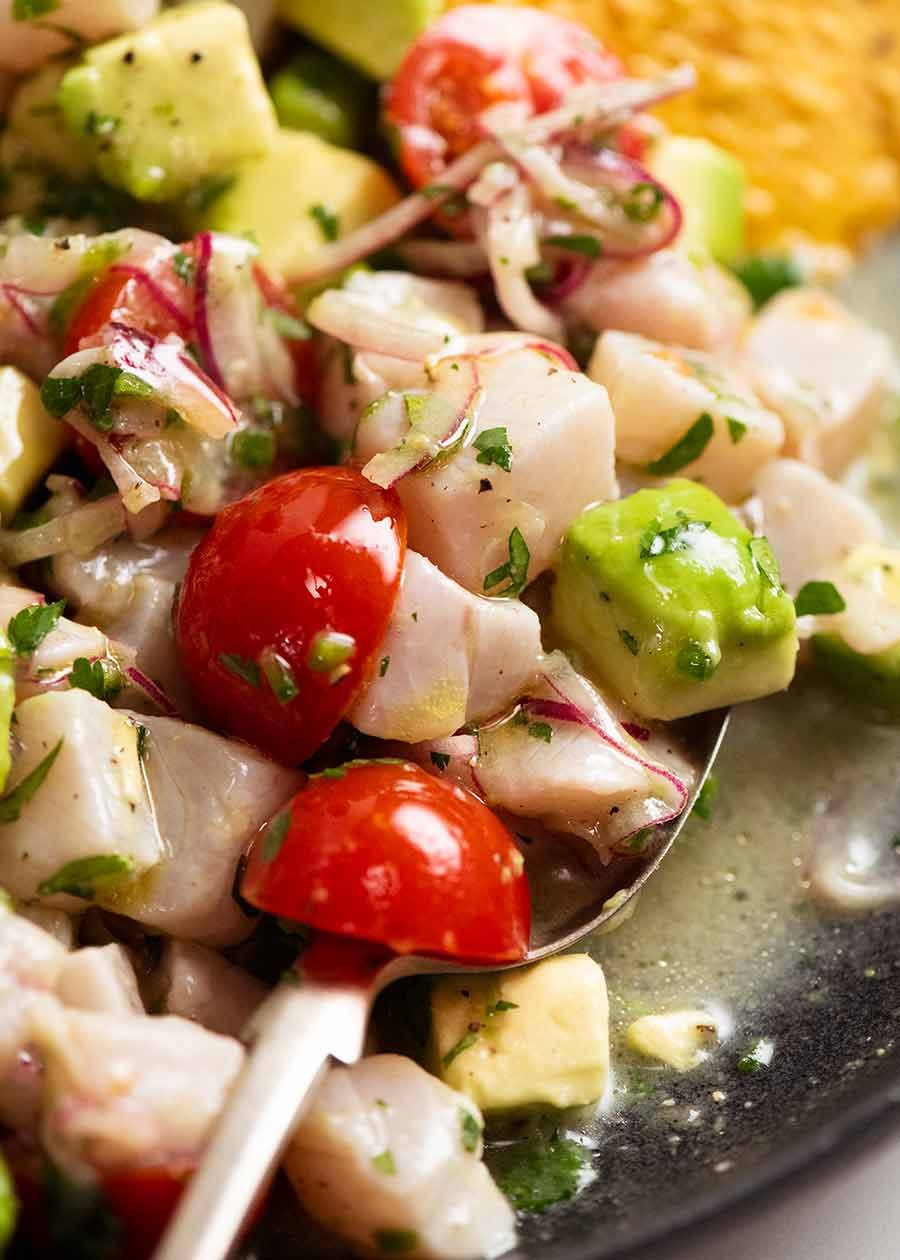
Ceviche
Originating from the west coast of South America, today ceviche can be found in various forms from Mexico down to Peru and beyond. It’s also a dish that has been embraced by fine dining establishments around the world. It plates up elegantly and is an ideal light seafood starter to precede a richer main.
Plus, it’s the sort of dish that people don’t ordinarily think of as simple to make at home, so restaurants readily charge a small fortune for it.
I’m here to bust that myth! As long as you can get your hands on sparkling fresh fish, ceviche is dead easy to make – and super quick too!
Buying sashimi-grade fish suitable for raw consumption is readily available these days, making dishes like ceviche infinitely accessible for ordinary folk like ourselves!
Raw fish + lime juice + 5 minutes = Ceviche!
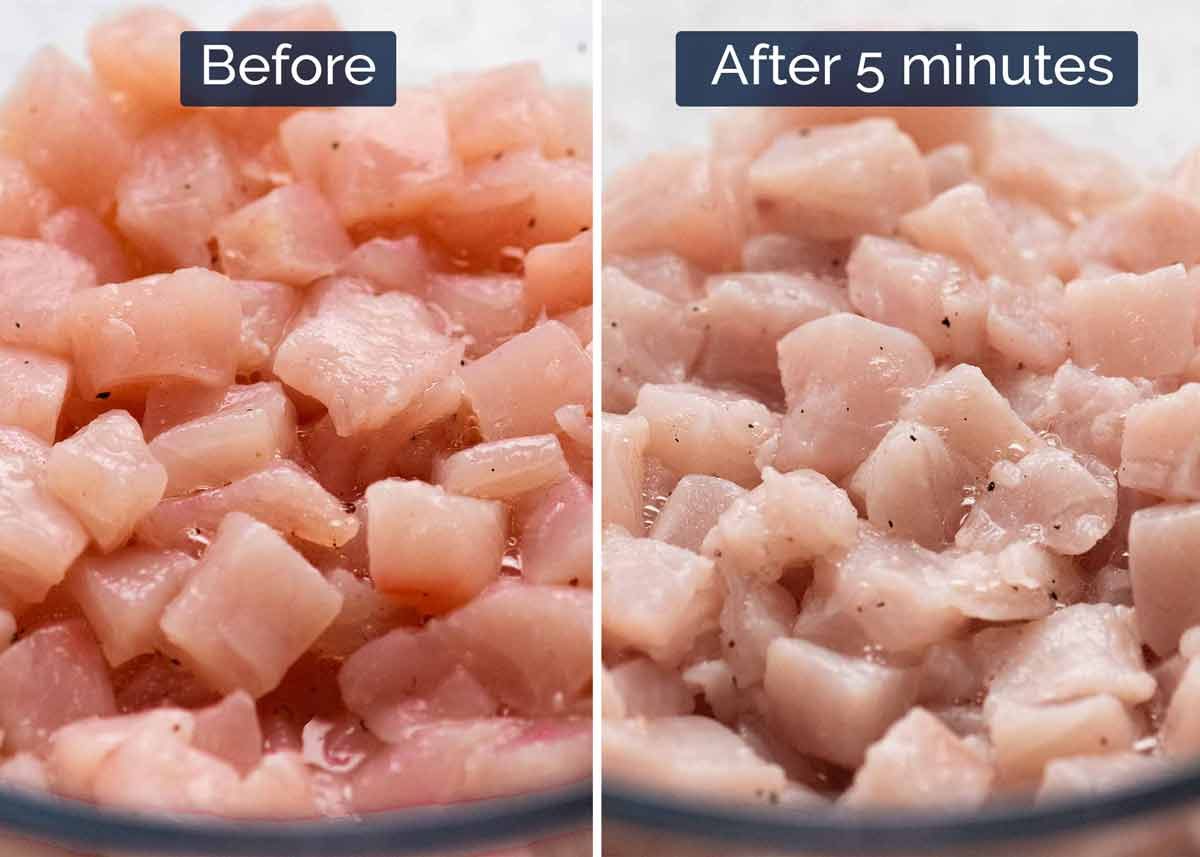
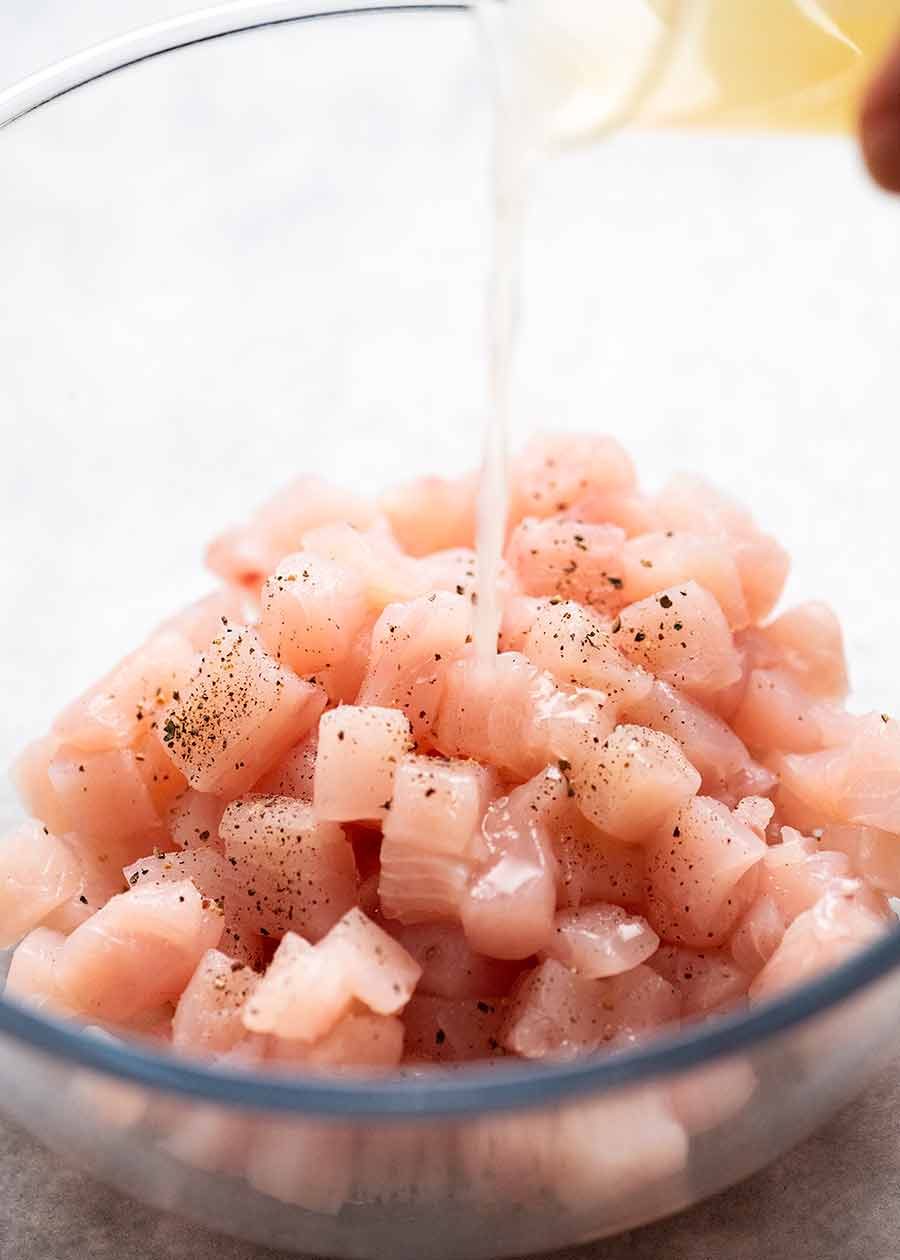
At its core, Ceviche is as simple as tossing raw fish with lime juice, then leaving it for 5 minutes to let the acid “cook” the fish, making it turn white on the surface, but still raw inside.
Here’s a comparison of the fish immediately after tossing with lime (fish is still translucent), then 5 minutes later, it’s turned white because it’s cooked!
It MUST be sashimi-grade fish
The ONLY fish you should use for ceviche is sashimi-grade fish that is suitable for raw consumption. It is not enough to just buy “fresh fish” from the stores – this only means it’s considered generally “fresh” from the fishmonger’s standpoint. It does not mean it’s necessarily fresh enough to eat raw. You need to check with the fish monger that it is “sashimi grade” (usually it will be helpfuly labelled 🙂 ) and is safe it eat raw.
I know that the thought of eating raw fish from the fishmonger versus at a restaurant might make some people nervous, but food safety standards nowadays here in Australia are such that you shouldn’t have cause for concern. I’ve been eating store-bought raw fish all my life since it became available in the late 90’s and I’ve never had a problem.
Of course, if you happen to have a fisherman friend, you can use virtually any freshly-caught fish – it’s all sashimi-grade! As a child, before sashimi was widely consumed in Australia, my parents would take us fishing every weekend just so we could catch fresh fish for sushi!
Best fish for ceviche
There is no one way to make ceviche, and there is no single “best fish” for ceviche because it’s driven by the types of seafood available in different regions! There’s plenty of options, so I’m going to list the most common ones for you:
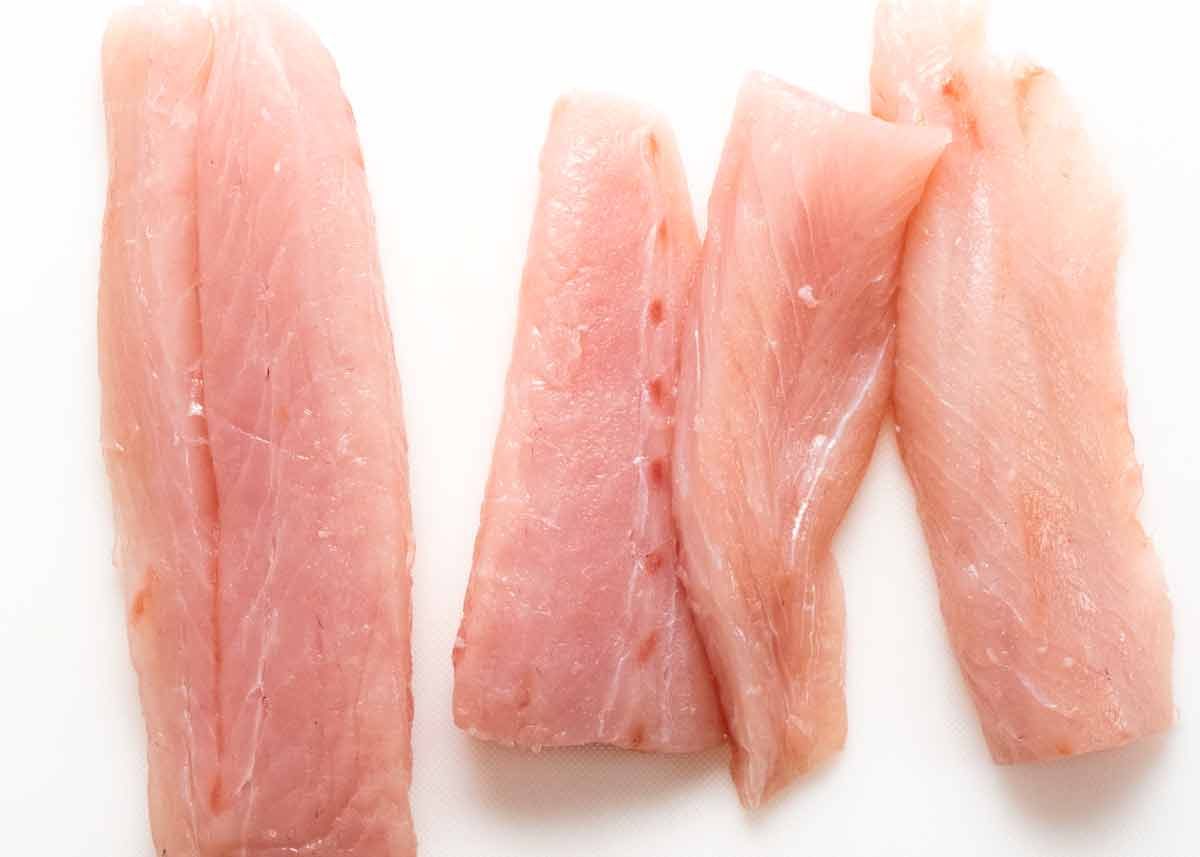
Kingfish (pictured above) – prized for it’s soft white flesh, very popular in Japanese sashimi (shows how good this fish is!). This is one of 3 common sashimi-grade fish sold at Australian fish shops (along with salmon and tuna) and a popular choice of fine dining establishments;
Sea bass – traditionally used for Peruvian Ceviche and easily found in the UK/US;
Tuna – popular in Mexico (along with prawn/shrimp);
Mackerel – also popular in Mexico;
Prawns / shrimp – traditional in Ecuador and popular in Mexico, often with a dash of tomato juice;
Halibut or Patagonian tooth fish – Chile;
Salmon – though not traditional (because white fish is traditional), salmon is excellent made into ceviche. Easy to find in Australia;
Bream – many species, depending where in the world and widely used;
Swordfish – if you are lucky enough to get it(!), this is used in some Latin American countries.
Trevally – Although we haven’t seen it mentioned, raw trevally is beautifully soft-textured and would make a fine ceviche. Available at some good fishmongers here in Australia; and
Cod and mahi mahi – Popular options in America.
Fish that is not suitable for Ceviche
As a general rule, fish that are tender and not chewy when raw will make better ceviche. This is because the fish in ceviche is cut chunkier compared to the fine slices used in say fish carpaccio or sushi. Thus fish like snapper, grouper, some cods, flounder, which can be sometimes a bit tough eaten raw, are less suitable.
There’s no one way to make ceviche. Each country, city, restaurant and household has their own way. At its core, however, the avocado and jalapeño in this makes this a Mexican Ceviche.
What (else) goes in Ceviche
Here are the other ingredients required for this recipe:
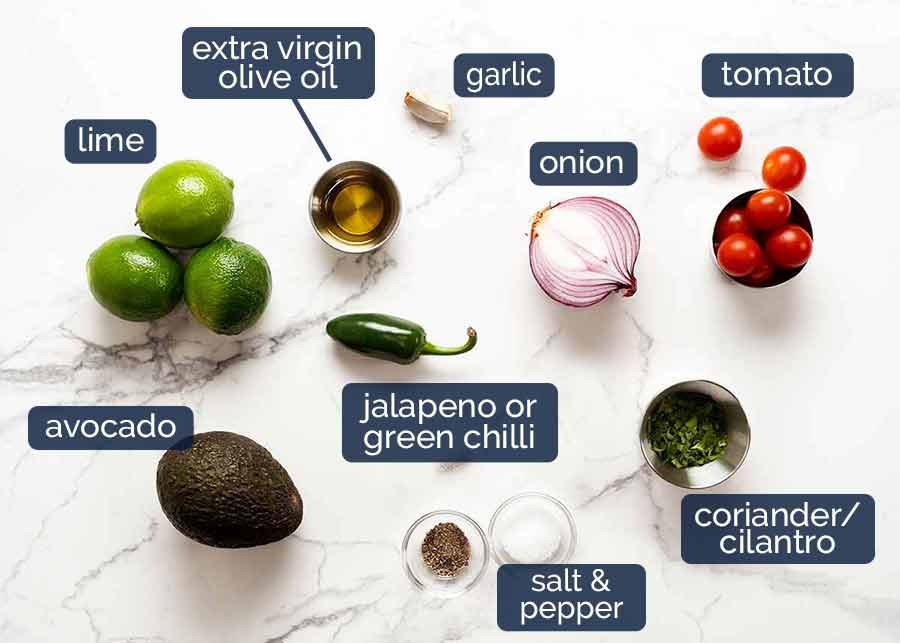
Limes – the essential ingredient that “cooks” the fish;
Extra virgin olive oil – just a touch will take the sharp, sour edge off the otherwise totally sour dish. It’s not strictly traditional to include this, but it’s important to know that limes in Latin America – certainly in Mexico – are often not as sour as those in most Western countries, including Australia and the US. Without oil, I find Ceviche is too sour. Even in Mexico, I found most Ceviches there to be too sour! (*She ducks as Mexicans throw rotten tomatoes at her!*)
Avocado and jalapeño – these add ins are traditional in some versions of Ceviche found in Mexico. Creamy pieces of avocado are a sensational pairing with the delicate pieces of fish!
Coriander/cilantro – essential fresh herb flavouring for ceviche. Coriander haters – sub with chives;
Red onion – very finely sliced so it flops and melds with the fish;
Garlic – crushed using a garlic press so it’s minced finely and “juicy”. We just use 1 small clove – it shouldn’t be overly garlicky; and
Tomato – included in some traditional versions, I really love just adding a bit (not too much) for beautiful pops of colour and fresh juiciness.
How to make Ceviche
The making part is very simple, but I’ve found the key is the order in which ingredients are added – ie what is marinated with the fish, and what is best added later.
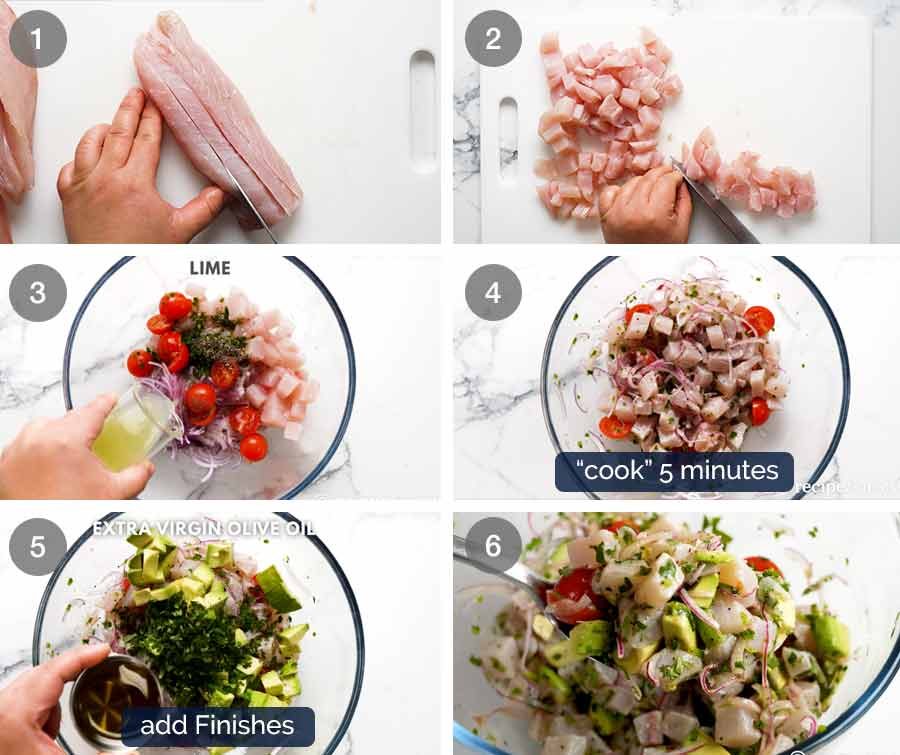
Fish – cut the fish into long strips;
Dice – then cut it into small cubes;
Combine fish with tomato, onion, jalapeño, pepper and lime juice. Do not add salt (this draws water out of the fish), avocado (these get bashed around too much when tossing) or olive oil (this dilutes the acidity of the lime juice and slows down the cooking too much);
“Cook” 5 minutes – gently mix, then set aside for 5 minutes to let the lime “cook” the fish;
Add olive oil, avocado, fresh herbs, salt then gently mix;
Serve immediately.
Despite what other recipes will tell you, there’s no need to be in a manic rush to get the ceviche on the table within 10 seconds otherwise the lime will over cook the fish. Ceviche is certainly best eaten fresh, but it’s still wonderful 20 minutes later. It’s not until around the 30 minute mark that the fish becomes a bit too firm for my taste (literally completely cooked through – but not like stove cooking so it’s not the best texture).
Note: In some countries (such as Peru), ceviche is traditionally left to “cook” for several hours in the lime but larger pieces of fish are used. I like using small pieces – for better texture and ease of eating.
How to serve Ceviche
Just as there is no one way to make Ceviche, there are plenty of ways to serve it too!
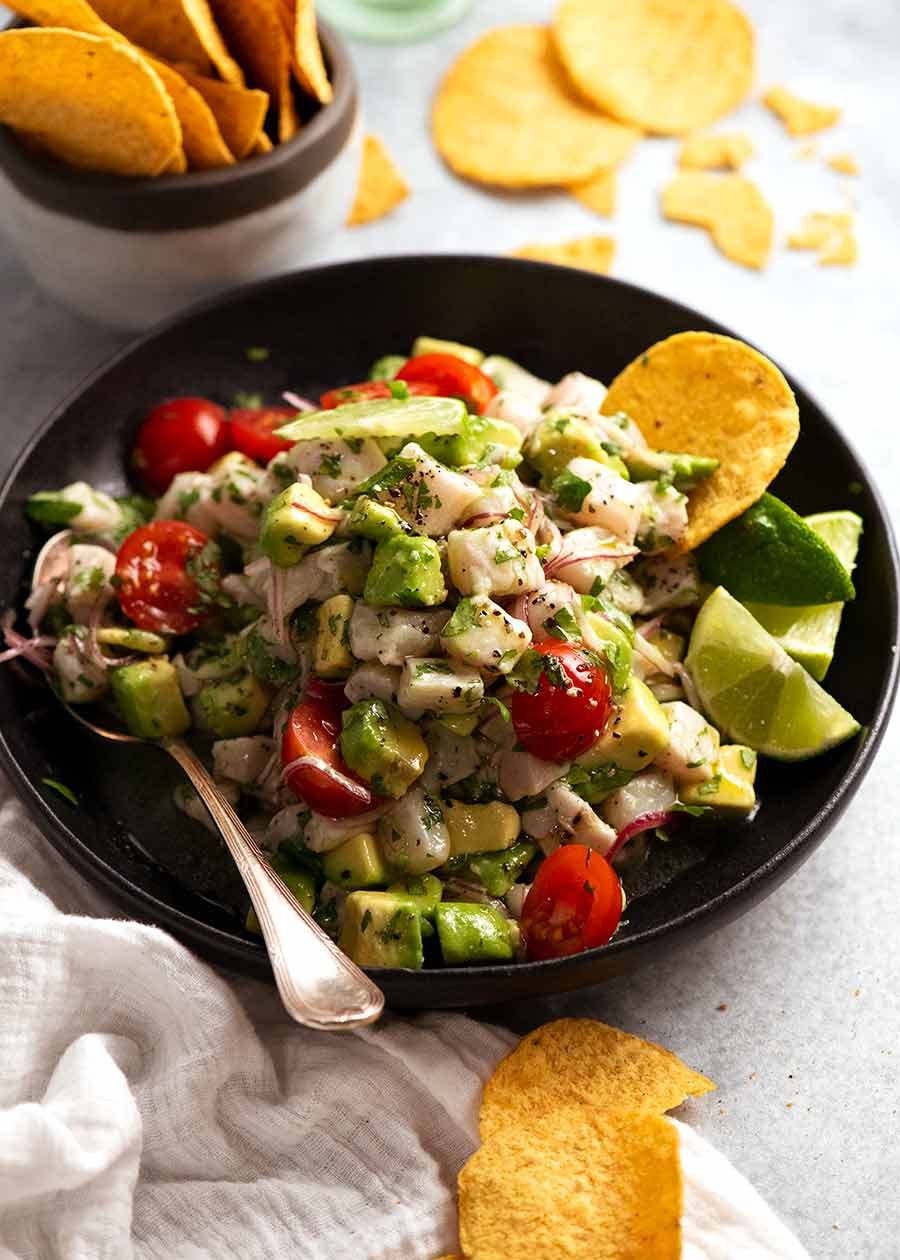
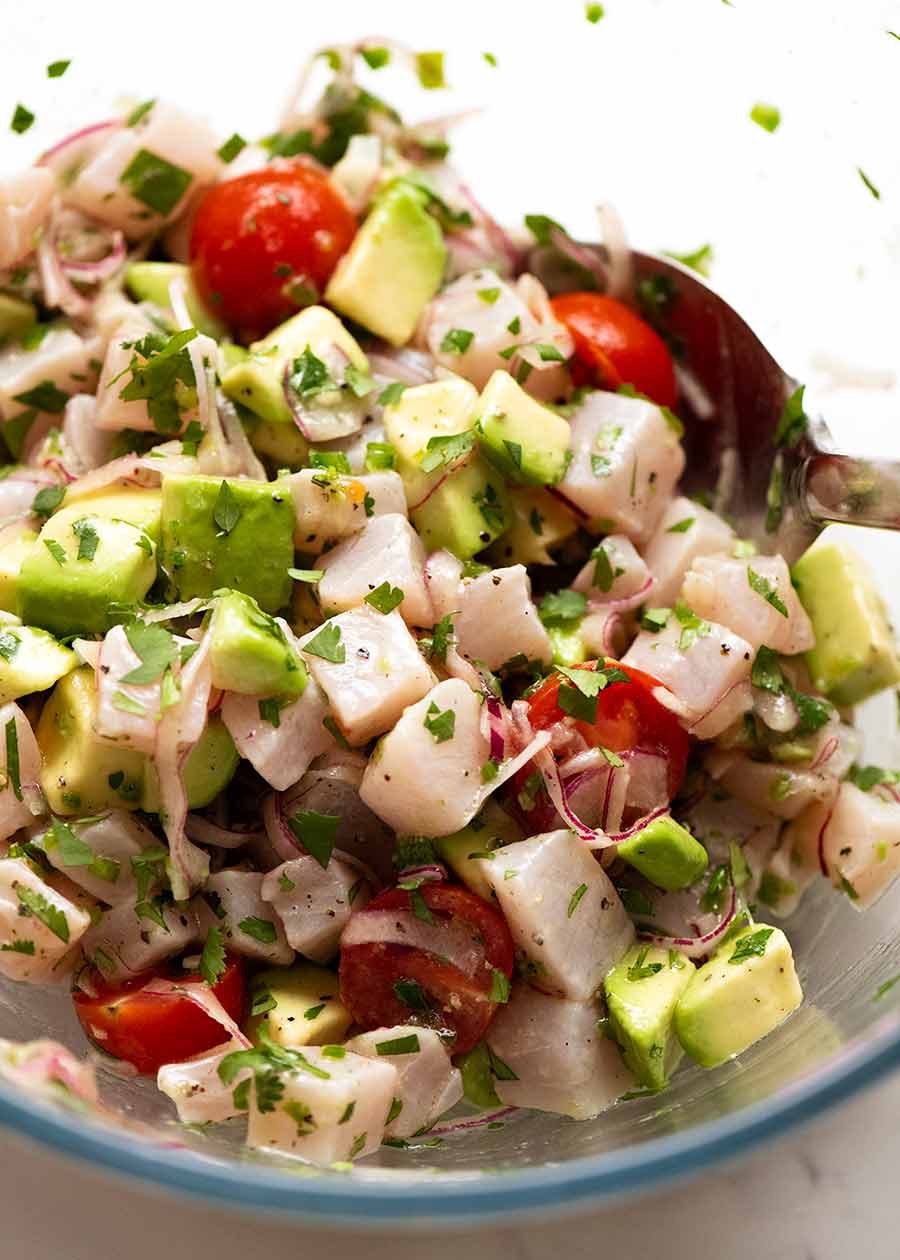
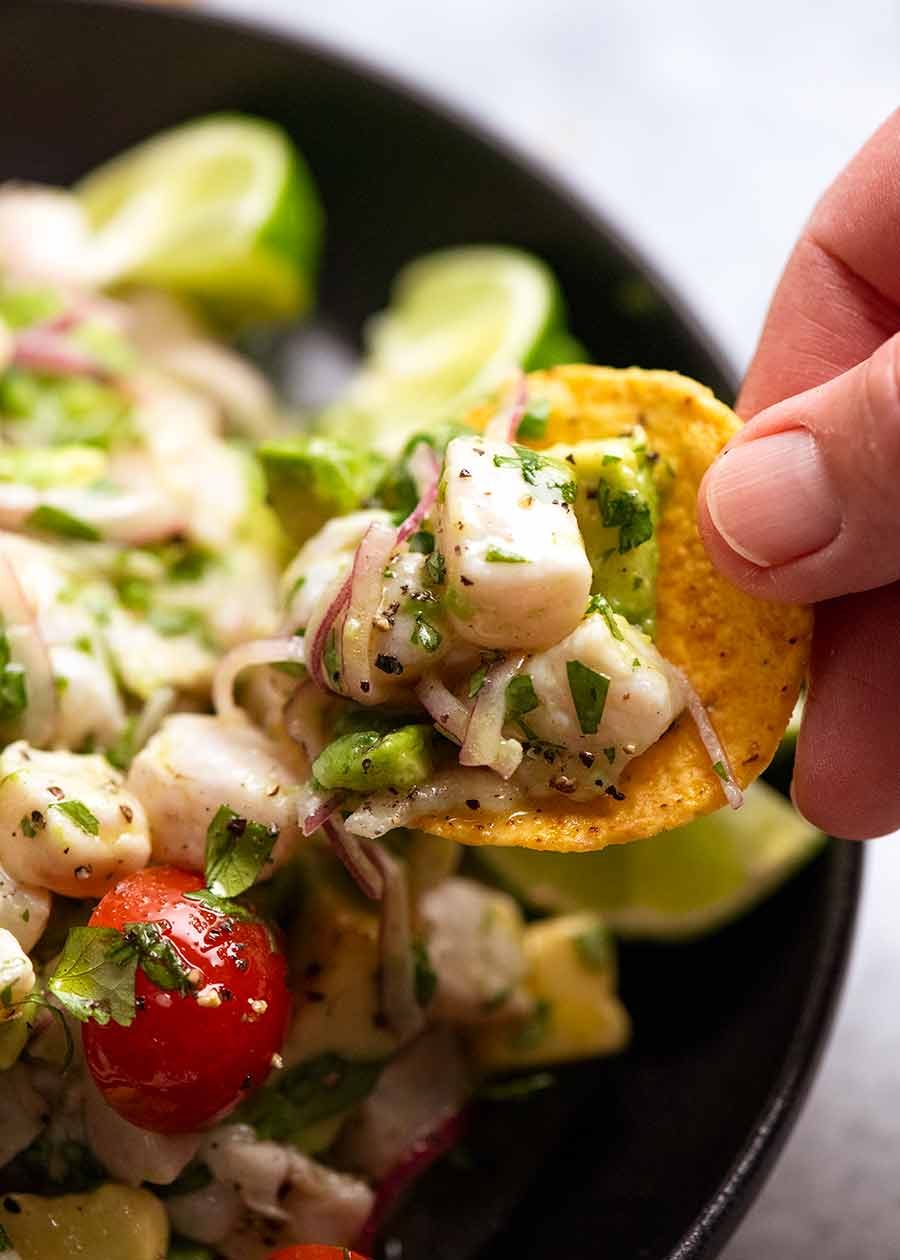
In Mexico and other parts of Central America, it’s often served in small “cups” or dishes , cocktail style, with corn chips or crispy tortillas/tostadas for scooping, as pictured above. I like using this idea to make platters of canapés to pass around at gatherings, as pictured on the below right.
In Peru it’s served as a meal with corn on the cob, slices of cooked sweet potato and sometimes with rice. In other countries it comes with plantain chips or rice.
In fine dining restaurants, it’s served in all sorts of fancy ways. One easy way is to spoon individual portions into a small dish with a side of crostini on the side (toasted small bread), as pictured below.
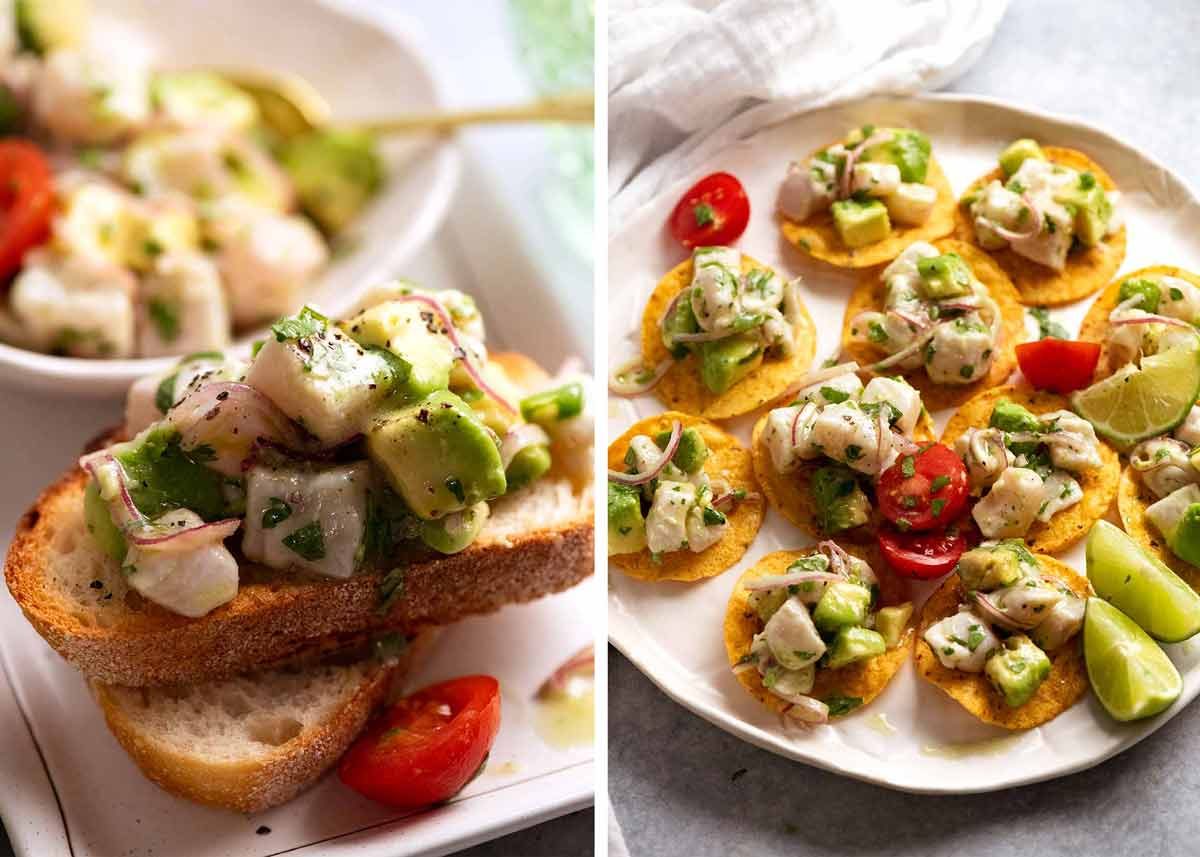
Of course, you can just by-pass all of that and just devour it straight out of the bowl with a spoon, which is exactly what I did. 🙂
I really hope you give this a go one day. Especially those of you who have previously been turned off by overly sour ceviche in the past.
Now – go make friends with some local fishermen! 😂 – Nagi x
Watch how to make it
Hungry for more? Subscribe to my newsletter and follow along on Facebook, Pinterest and Instagram for all of the latest updates.
Ceviche
Ingredients
“Cooked” fish:
- 400g / 14 oz kingfish, tuna, sea bass or other sashimi-grade fish suitable for raw eating (Note 1)
- 1/4 red onion , very finely sliced using mandolin (so it "flops")
- 2 tsp fresh jalapeño , finely chopped (or green chilli) – add more or less for spiciness
- 8 cherry tomatoes , halved (large ones quartered)
- 1/4 tsp black pepper
- 1/3 cup lime juice , fresh (or lemon juice)
Add ins:
- 1/2 tsp salt , cooking / kosher (or 1/4 tsp table salt, Note 2)
- 1 avocado , ripe, cut into 1.25cm / 1/2″ cubes
- 1/4 cup coriander/cilantro leaves , roughly chopped (sub chives)
- 2 tbsp extra virgin olive oil (Note 3)
Instructions
- Cut fish: Cut fish into 1.25cm / 1/2" cubes.
- Toss in lime, leave 5 minutes: Place in a bowl with onion, jalapeño, tomato, pepper and lime juice. Gently toss, then set aside for 5 minutes, mixing gently once.
- Add avocado then serve! Sprinkle over salt, then add avocado, coriander and olive oil. Gently stir, then serve immediately with corn chips (see in post for other ideas).
- Ceviche will be good for 20 minutes or so, then fish will start to overcook and firm up. Do not leave overnight (for food safety reasons).
Recipe Notes:
- Kingfish (pictured in post)- popular choice of fine dining establishments
- Sea bass – traditional in Peruvian
- Tuna and mackeral – popular in Mexico
- Prawns / shrimp – traditional in Ecuador, popular in Mexico
- Halibut or Patagonian tooth fish – Chile
- Salmon – not traditional but excellent for ceviche
- Bream – many species all around the world
- Swordfish – used in some Latin American countries.
- Trevally – not traditional in South America, but beautifully soft-textured and excellent for ceviche
- Cod and mahi mahi – Popular options in America.
Nutrition Information:
More Fresh Fish recipes
More recipes that make the most of sparkling fresh fish!


Life of Dozer
Lazy bugger – stretching out as far as he can to rescue his toy because he can’t be bothered to dive back in. Can you imagine if pool Lifeguards had the same attitude?? I’m gonna stretch out to try to save you, but if I can’t reach you without getting my feet wet then too bad, I’m gonna leave you floating facedown in the pool! 😂

Hi Nagi,
I LOVE your recipes and inspiring emails, I first fell I love with your site after finding your beef rendang recipe, its THE BEST and I make it all the time as well as the one pan Greek chicken risoni!!
My favourite fish is coral trout and I live in Newcastle, NSW, Australia.
Thanks for being amazing and give Dozer a cuddle from me!
Colorado, US here! I know shrimp doesn’t count as a fish but it’s my absolute favorite! Can’t get enough of it! For “actual” fish…sashimi-style tuna, definitely
Hi! I’m from Ontario, Canada and my favourite fish is salmon!
Nagi my favourite fish is salt water barramundi but I also love mullet from the Coorong, in South Australia – sadly scarce these days but I remember they were so plentiful they were a real budget item from my local fishmonger.and tasty! Fried in a skim of butter for a flash of time sprinkled with salt, sublime. I guess the other fish I love being a SA gal, is whiting, cooked the same as for mullet – simple is best, dont you think?
With this recipe though, Barra would be better I think, just because it is meatier.
NSW, Australia.
One of my favourite types of fish to eat is Snapper – partner and kiddies occasionally catch me one!
Perth, Western Australia
Our family fav is the Vietnamese Coconut Caramel Chicken. Yummo! 😋
Hello from Marietta, Georgia, USA. I’ve only had tuna ceviche so, by default, that would be my favorite. Looking forward to trying your recipe with some, maybe all of the fish you recommend.
Virginia, USA
Fried Fish, Luisiana Style
I live in Victoria, Australia! I love most fish especially when it’s Japanese cuisine 🤤
Nagi I’ve never cooked such a variety of recipes until I found your page last year. Thank you. I would like to ask if my favourite fish Barramundi is suitable to use in Ceviche.
I’m a salmon person(fresh only) I have.been spoiled with having fresh simple British fish n chips. I think it was cod
I first tried it in Peru a few years ago but this recipe worked well and was much tastier than that. I used sea bass. Keep them coming Nagi
We LOVE ceviche and it’s a stable in our winter getaway in Mexico. Shrimp is my favourite, avocado, red onion, plenty of red onion, and cilantro, avocado cubed but no jalapeno due to poor digestion issues. Sometimes I add mango after I’ve drained the limejuice. YUMMMM. Your recipes are my “go to” and so far… every single one has been excellent!! Thank you :-))
My husband and me (From Victoria, australia) love fish, but not as much as our dog shadow (yes, he’s the spoilt one who gets sushi grade tuna on special occasions)
Hi Nagi!
Greetings from San Antonio, Texas, USA!
I’m partial to Fresh caught Gulf of Mexico red snaPaper.
Hi Nagi
Thanks for a chance to win.
I’ll be trying this dish for sure as the weather warms up here in Newcastle NSW.
I’ll use tuna – it’s my fave!
Margaret Winter
Nagi, I love your website. The videos, tips and information you share and amzaing recipes. You never fail to disappoint. Love the Knife as well. I’m in Victoria and thank you for your constant support to us all. Salmon is my favourite fish.
My favor fish is salmon, but I like all kinds
Vic, Australia. Love fish recipes, but living in country Vic it is impossible to get good quality fish.
Hi Nagi. I’m a long time fan of your recipes and read your site every day.
My favourite fish is either smoked haddock or lemon sole, depending on my mood.
I live in Ayrshire in Scotland, where we are famous for our seafood.
If I win the knife it will be put to good use.
Many thanks.